


The Changemakers Circuit
From message to movement.
Speaking and engagement programming for the people who actually decide what a girl’s season is like — her teammates, her coach, her parents, the athletic director, the boys on the next field. Culture change starts with the right conversation, held in front of the right room.
What makes it different
Most programs talk to the girls. This one talks to the room.
There is a version of this work that consists entirely of telling teenage girls to be confident. It is popular, it is cheap to deliver, and it puts the entire burden of changing a culture on the person in it with the least power. The Circuit does the opposite.
Culture is made by adults
What gets said at practice, which teams get the good gym slot, whose parents show up, how a coach responds to a mistake. A girl does not control any of that, and a talk aimed only at her cannot change it.
Boys are in the room on purpose
The fourteen-year-old boy who thinks girls’ sport is a lesser thing becomes a coach, an athletic director, or a father. Whether he keeps thinking it is largely settled before he is twenty.
One conversation, everybody present
The Circuit is built so that a school can put girls, boys, coaches and parents in the same session and have them hear the same thing at the same time. Shared language is what makes the change stick after we leave.
Who we speak to
Six audiences, and often several at once.
Confidence, resilience, and building a leadership identity that does not depend on being the best player in the gym.
What genuine allyship looks like on a team, in a hallway, and in a locker room when nobody is watching.
How to support a daughter in sport without becoming the reason she stops enjoying it. Positive, equity-minded, practical.
Building a team culture where belonging is designed rather than hoped for — and where returning next season is the default.
What a school can actually change to keep girls in sport, from scheduling and facilities to how participation is funded.
For groups whose stated values include women’s advancement and who want the practice to catch up with the statement.
Topics
Six starting points, shaped to your room.
These are the sessions we run most often. Every one is adjusted for the audience, the age, and how long you can actually hold the room — a forty-minute assembly and a half-day coaching clinic are not the same talk delivered at different speeds.
Confidence & Resilience
Building mental strength through sport — what actually produces it, and what only sounds like it does.
Mental Wellness in Athletics
Normalizing the conversation in environments that have historically rewarded saying nothing.
Healthy Team Culture
What it takes, and specifically whose job it is. Usually not the person everybody assumes.
How to Support Girls in Sports
For coaches, parents and allies who want to help and are not certain what would actually be useful.
The Athlete-to-Leader Transition
From the field to a career — what transfers, what has to be relearned, and why the gap catches people off guard.
Leadership Lessons from the Locker Room
Being coached, losing in public, leading people who did not choose you. Applies to any room, including a boardroom.
The principal voice
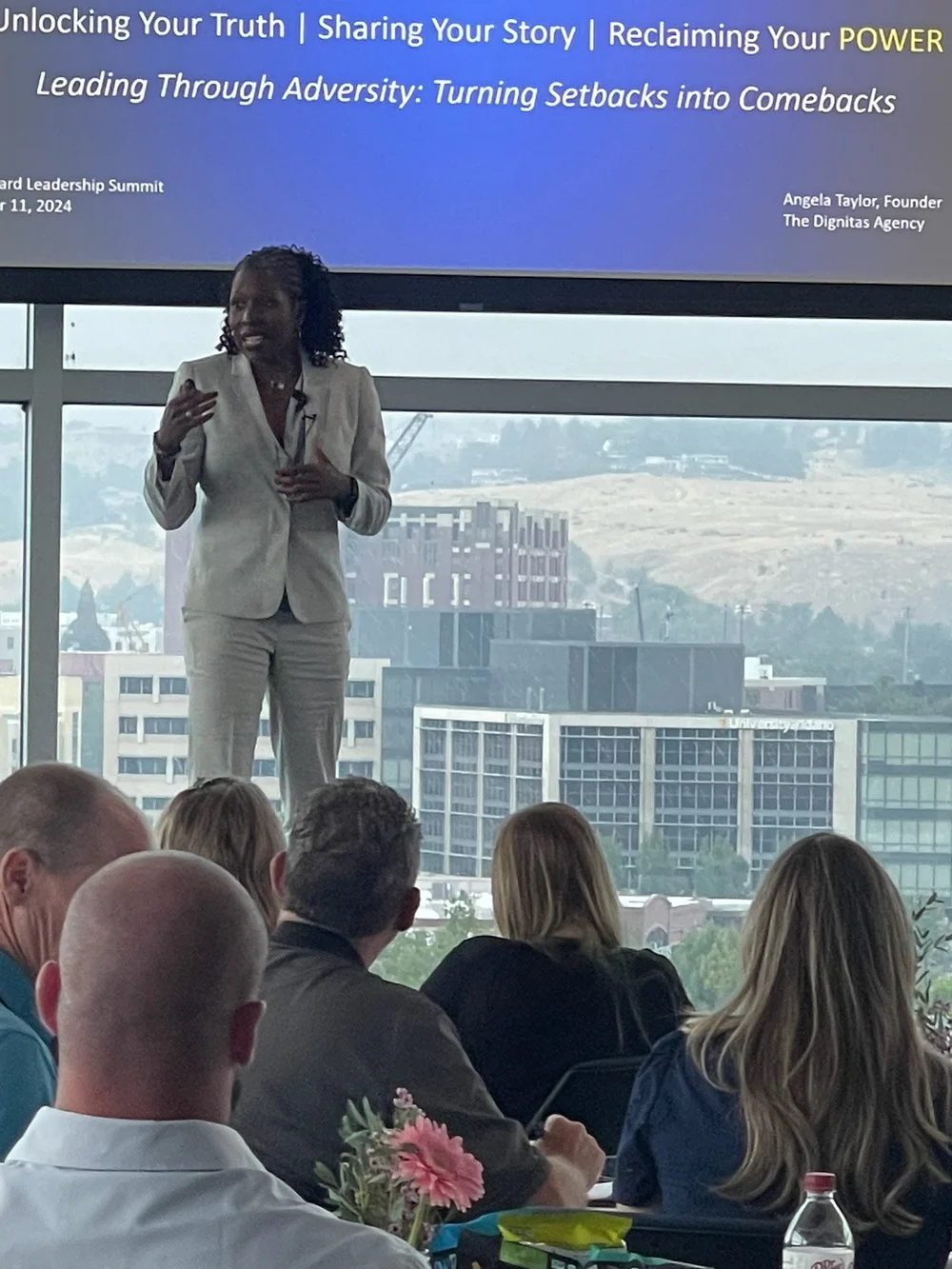
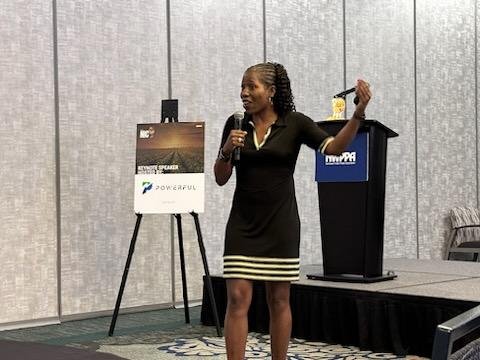
Angela Taylor has been in most of these rooms from the other side.
A Stanford scholar-athlete who walked on and earned a full scholarship two months later. A two-time NCAA champion. An MBA from NYU Stern. A President and General Manager in the WNBA. And a woman from Mountain Home, Idaho, whose parents — a career airman and a special-education paraprofessional — taught three children that the classroom and the field were the same job.
She is not describing the athlete-to-leader transition from research. She made it, in public, in an industry that was not built for her.
The speaker bench
Not one calendar. A roster.
Angela is the principal voice, and she is not the only one. A program that depends entirely on one person’s availability is a booking risk for you and a ceiling for us, so the Circuit draws on a deliberately wider bench.
Who may be in front of your room
- Angela Taylor — Founder, and the principal voice of the Circuit.
- Board and committee members — leaders across business, education and athletics in Idaho.
- LEAD Fellows — scholar-athletes in college and early career, which is exactly the right distance from a high school audience.
- Networking Collective members who have completed the speaking cohort.
- The Foundation’s wider network, including professional athletes and executives from Angela’s career in the WNBA and beyond.
Why the bench is part of the mission
The Collective runs a speaking cohort that trains women to stand up in front of a room and say something worth hearing. Those women then get paid work doing it.
So a Circuit booking is not only a session for your students. It is a stage for a woman who is learning to command one — which is the same athlete-to-leader transition this whole Foundation exists to shorten.
Tell us your audience and we will match the speaker to the room. A fourteen-year-old hears a twenty-two-year-old differently than she hears anyone else, and sometimes that is precisely the right call.
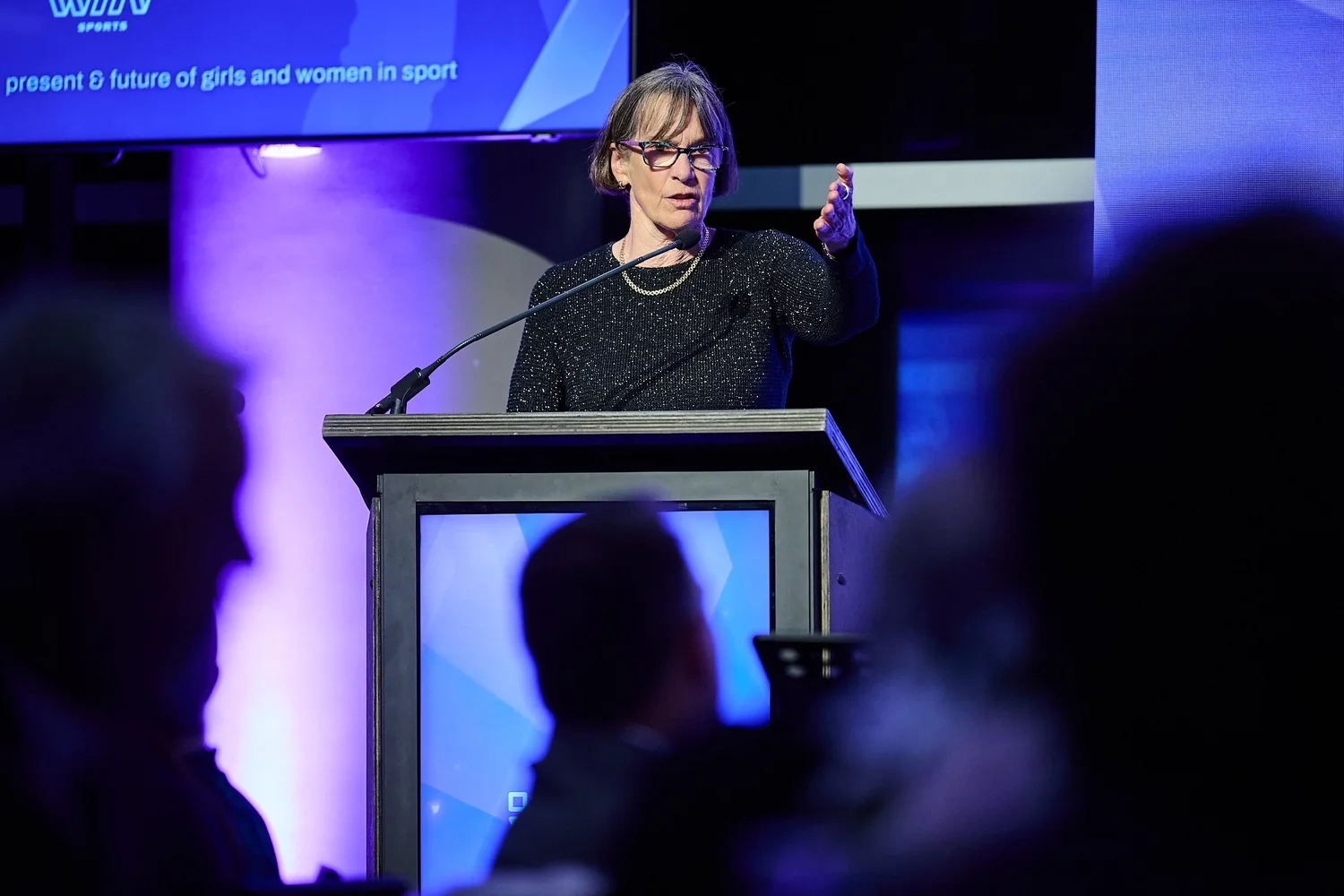
Tara VanDerveerNaismith Hall of Fame head coach — 1,216 career wins, three NCAA championships, Olympic gold. Keynote speaker at the inaugural Change Make*Hers Gala, and Angela Taylor’s head coach at Stanford.
Already delivered
The first session was at Mountain Home High School.
A paid engagement, delivered before the program formally launched — at the school Angela graduated from in 1989, and the school where this Foundation’s scholarship began in 2015. Going back to speak to their students was not a soft launch. It was the point.
Since then the girls’ flag football coach at Boise High School has approached us about bringing a session to his program — inbound, with no outbound on our side. Flag football is brand new for girls in Idaho, which makes it the clearest possible case for this work: nobody has decided yet what that culture will be. Somebody is going to, and it may as well be on purpose.
Your message is truly inspiring, as well as celebratory of your experiences and the significance that Mountain Home and MHHS have meant to you. Having been in the classroom for over 20 years, this has been a theme that I have hoped students, coworkers, and myself continually keep in perspective.Sarah DeVore Activities Director, Mountain Home High School
Her full remarks are in the one-page overview.
Formats
Tell us the room and we will shape it to fit.
Length, audience and topic are all adjustable. What does not change is that the session is built for the specific group in front of it rather than delivered off a shelf.
One message, large audience, everybody hearing it together. Best when the goal is shared language across a school rather than depth with one group.
Smaller, more direct, and more honest. Works particularly well at the start of a season or immediately after a difficult one.
Practical rather than inspirational. What to say, what to stop saying, and which decisions quietly determine whether girls come back next year.
Leadership lessons from sport applied to workplaces, plus a candid account of what women’s advancement actually requires from the people already in charge.
What it costs
Sessions start at $500 for a 30-minute talk.
From there it scales with length, format and who is delivering it — a half-day coaching clinic is a different commitment from an assembly, and a keynote from Angela is priced differently from an early-career speaker off our bench.
Corporate and community bookings are priced to support the program. Idaho schools and youth organizations are not: if the number is the obstacle, say so in the inquiry and we will work with what you have. We would rather find a way than lose the room.
Sessions are available across Idaho and, where travel allows, beyond it.
For the conversation you are not in
You are probably not the person who signs this off.
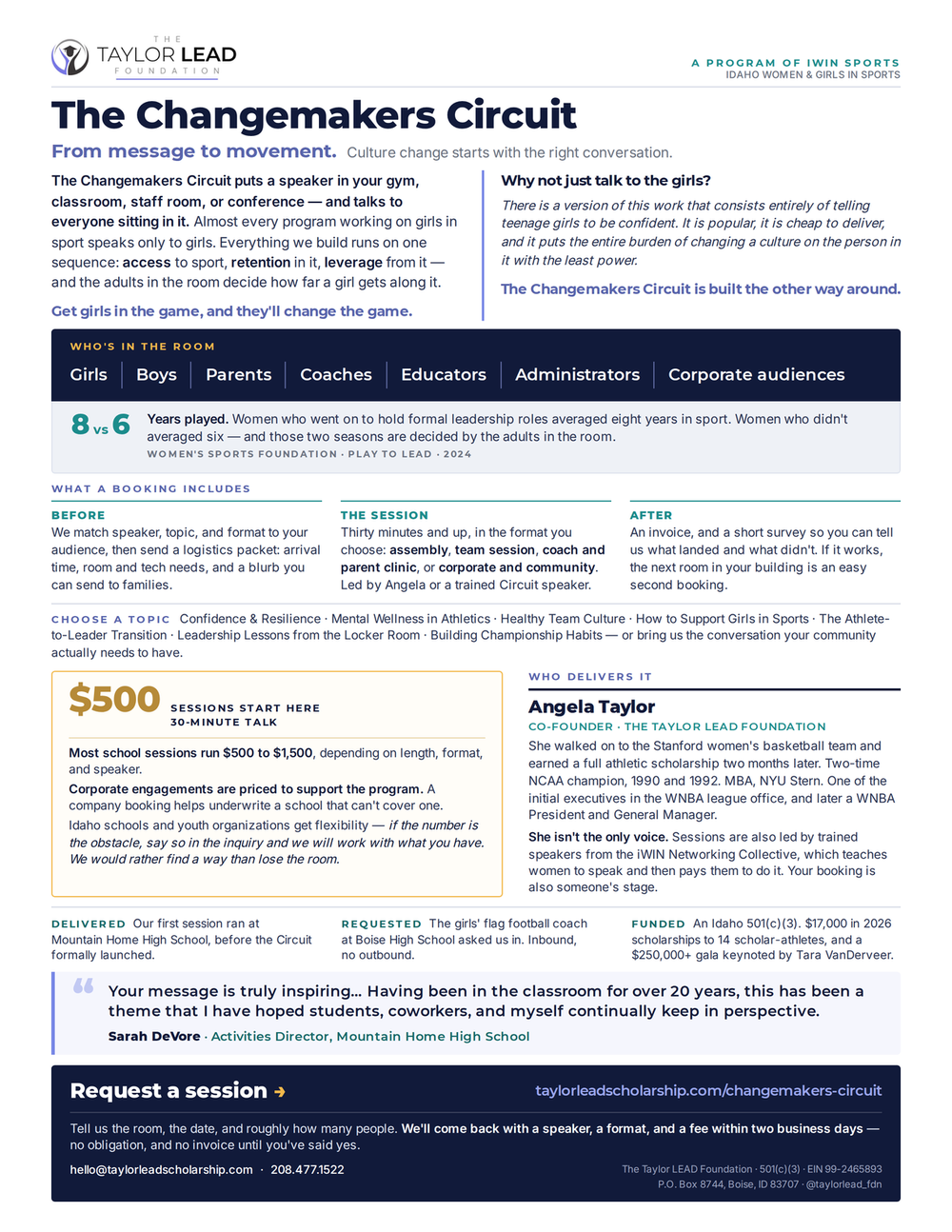
Most people who bring us in have to convince somebody else first — a principal, an activities director, a business manager, a booster board. This is the page you forward to them. One side of paper, everything they will ask.
- What the Circuit is, and who is in the room
- The four session formats and what each one suits
- What it costs, stated plainly
- Who is speaking, and why that matters
- How to book, and who to ask
Book a session
Tell us who is in the room.
Nothing here commits you to anything. Tell us roughly when and who would be there, and we will come back with whether we can do it and what it would cost. The more specific you are — the age, the sport, what prompted the ask — the better the session will be. If you are not sure which topic fits, say that instead; working it out is part of what we do.
Would rather write a paragraph?
Some people find a blank email easier than a set of fields, and on a booking like this those are often the better first messages. Tell us the school or organization, roughly when, and who would be in the room.
Need to get approval first?
Take the one-page overview and forward it. It answers what it is, who it is for, what it costs and how to book — which is usually the whole conversation.
What happens next
We reply within two business days, usually sooner. If your date is tight, say so in the form and we will move on it. Nothing you send commits you to anything — most first conversations are about working out whether this is the right fit at all.
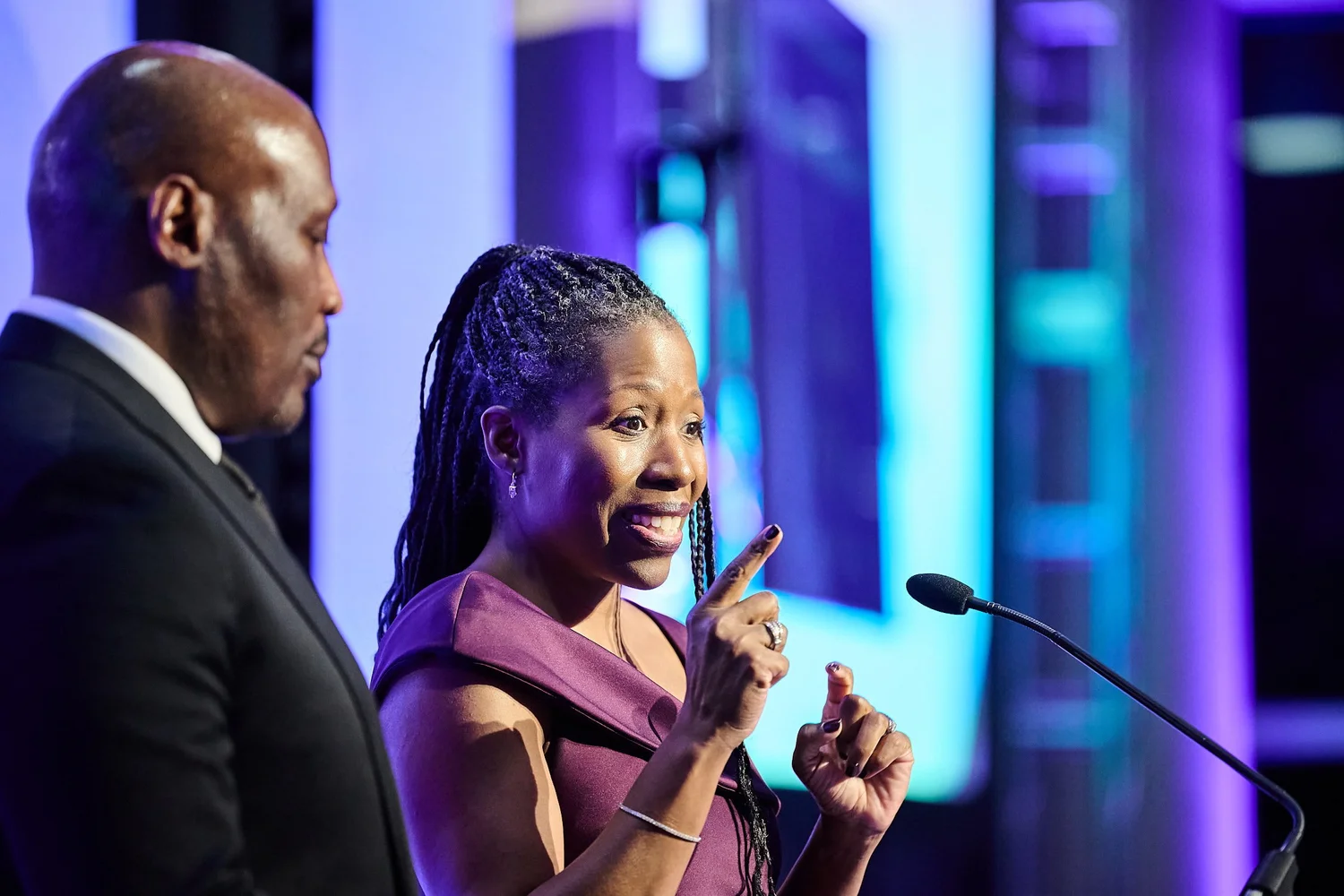
The Changemakers Circuit
Somebody is deciding what your team’s culture is. It may as well be deliberate.
Culture forms whether or not anyone intends it. The only question is whether the people shaping it have ever been asked to think about what they are shaping.
The Changemakers Circuit is a program of iWIN Sports, a platform of The Taylor LEAD Foundation.