

Impact
What we funded.Who it reached.
This page is a ledger. Every figure below is a real transaction from a real year, and every one of them is small enough to check. We are two years in, and the numbers are small.
Figures are drawn from Foundation and family records and are unaudited. Gala proceeds are stated gross. Pre-2024 scholarships were personal gifts from the Taylor family and are not Foundation revenue. This ledger is republished every quarter; the next update is scheduled for October 2026.
How to read this page
These are inputs. The outcomes come later, and we will say so when they do.
What is on this page
Money moved, girls funded, scholars named, applications received. Countable things that already happened, with the year attached.
What is not on this page
Retention rates, confidence gains, leadership outcomes. We have not completed a season-over-season cycle, so we do not have them. The first set is due in 2027.
Where the evidence lives
The national research, the Idaho baseline, and the framework we measure against are on the research page — kept separate so this one stays a record of what we did.
The scholarship
The 2026 cycle, start to finish.
The first year of the statewide expansion. Districts III and IV joined Mountain Home, which is eligible every year and always will be. Publishing the whole funnel rather than only the award count is deliberate — the shape of it tells you where demand is and where our review capacity sits.
Half the students who started did not finish. That is a friction number, not a demand number, and it is the most improvable figure on this page. Three things change before the portal opens on December 1: the application is being tested end to end rather than launched cold, the communications plan runs across the whole window instead of clustering at the open and the close, and the window itself is wider — because students do this work in the gaps they actually have, which for most of them is the last week of December.
Awarded in 2026
Across 14 recipients, including $6,000 to three Mountain Home High School scholars.
Completed applications awarded
14 of the 35 students who completed an application were named LEAD Scholars. A further 37 started one without finishing.
What the funnel tells us to fix. Thirty-seven students started an application and did not finish it. We count them here on purpose — they are a measure of how far word traveled in the first year of the statewide expansion, and a design problem we own rather than a signal about the students. Shortening the application is the first thing we are testing before the January 2027 portal opens.
Ten classes. Nine of them paid for by one family.
Before there was a Foundation, a board, or a tax deduction, the Taylor family funded these scholarships personally — more than $15,000 to 20 recipients between 2016 and 2025. The first year’s gift, in 2015, went to Mountain Home’s girls’ and boys’ athletic programs rather than to students.
Two years in that run have no recipients, and both are on the record. In 2020 the pandemic meant Idaho athletes never finished their seasons. In 2024 there were applicants, but none who met the criteria — and rather than lower the bar, the family named nobody.
We publish that second year deliberately. A scholarship that is always awarded is a gift. A scholarship that is sometimes withheld is a standard.
iWIN IX Grants
Twenty girls into a season, at about $115 each.
Twenty girls from low-income families in Mountain Home will be funded into Girls on the Run this year through iWIN IX Grants — roughly $115 per award, about $2,300 in total. For many of them it will be a first organized sports experience. We did not run a campaign to find them. The need was already there, and the amount was small enough to move on quickly.
Girls committed for 2026
Mountain Home, through Girls on the Run.
Average award
What it costs to put one girl in one season. This is the number we would like every donor in Idaho to know.
Review, with no deadline to miss
Applications are open year-round and reviewed as quickly as we can manage, because a registration deadline does not wait for a review calendar.
Grant types
Momentum Grants for families, Camp Scholarships for individual girls, and Equity Grants for organizations serving girls at scale.
What we will report next. Every IX Grant application collects the cost category funded, the sport, the district, and whether this is the girl’s first organized season. Once the 2026–27 cycles close, that becomes a distribution we can publish — what a season actually costs an Idaho family, broken out by county. That figure does not currently exist anywhere. See the research agenda →
The Changemakers Circuit
Three sessions delivered before the program had a webpage.
The Circuit is speaking and engagement programming for the people who shape sports culture — students in one room, and the adults who fund, coach and govern them in another. All three sessions below happened ahead of the formal launch, which is the only reason they are worth reporting: nobody had been asked to buy anything yet.
What we will report next. A post-session feedback loop is being built — two questions, sent three days after every session, asking whether a host would recommend the Circuit and what they noticed afterward. Until that has run we have one testimonial and no outcome data, and we are not going to describe three sessions as evidence of anything more than demand. Separately, the girls’ flag football coach at Boise High School has approached us about bringing a session to his program. About the Circuit →
What a gift does
A season costs less than most people assume.
We are specific about this because vagueness is how nonprofits lose people. These are the actual amounts and the actual things they cover.
One girl, one season of Girls on the Run
This is not an estimate. It is what each of our twenty Mountain Home awards costs this year.
One IX Momentum Grant
Registration fees, league dues, gear, shoes, a uniform, or travel — the larger costs that keep a girl out of a season entirely.
Approximately one IX Grant a year
Recurring gifts are the most useful money we receive, because they let us commit to a girl in September rather than hoping in March.
Approximately one Game On! camp scholarship a year
Tuition, gear, and the access supports that decide whether a girl attends once or comes back.
A named program component
An IX Grant cohort, a Changemakers Circuit series, or a camp scholarship cycle — with quarterly reporting on what it funded.
Community
The inaugural Change Make*Hers Gala sold out, and Tara VanDerveer keynoted it.
February 2026. Everything on this page was funded from that room — and the person who opened it was the Naismith Hall of Fame coach who won 1,216 games, three national championships and an Olympic gold medal, and who began her head coaching career at the University of Idaho.
She also coached Angela Taylor at Stanford, on the 1990 and 1992 championship teams. A first-year foundation does not get that keynote on merit alone. It gets it because somebody spent thirty-five years earning the phone call.
Raised
Attendees
Volunteers
Student-athletes in the room
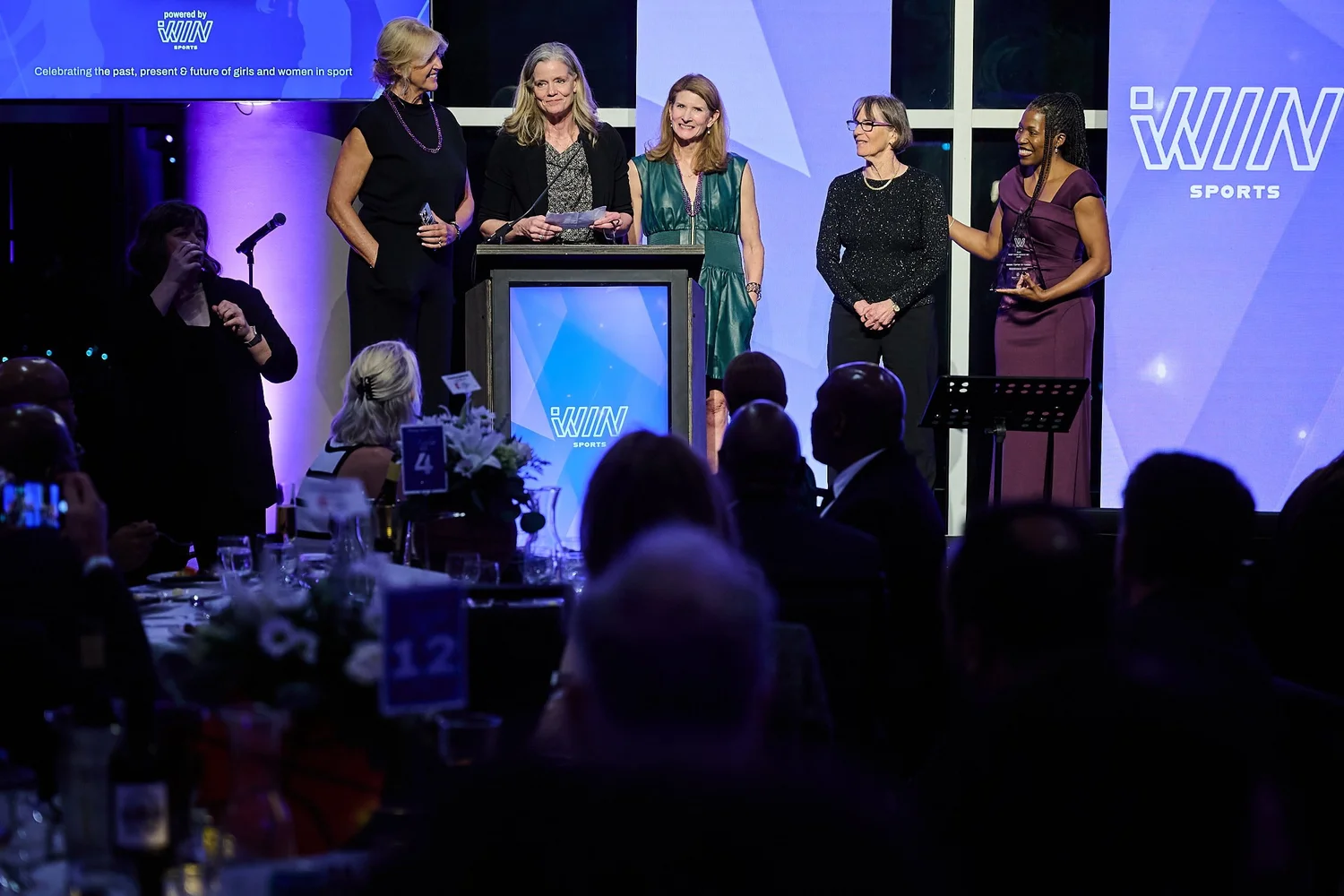
- Jill Yanke — Borah High School, and among the first players Coach VanDerveer coached at Stanford. Lives in Boise.
- Trisha Stevens Lamb — Stanford’s 1990 national championship team. Lives in Boise.
- Ann Enthoven — Stanford’s 1992 national championship team. Lives part-time in Driggs, Idaho.
- Angela Taylor — 1990 and 1992 championship teams. Co-Founder and CEO of this Foundation.
The invitation was deliberate, not opportunistic. Coach VanDerveer’s first head coaching job was at the University of Idaho, in 1978. Two of the players who presented her award live in Boise. The most decorated coaching career in college basketball began in this state, and the people who could say so in person were already here.
2026–2027 commitments
Six things we said we would do. Here is where each one stands.
Published so you can hold us to them. Status is updated every quarter alongside the ledger, whether or not the news is good.
Launch the iWIN IX Grants
Direct financial support so cost stops deciding who plays. Applications open year-round, reviewed quarterly.
Expand camps and clinics through the ages 12–14 window
Game On! Sports Camps 4 Girls in Boise, plus partner clinics statewide.
Activate the Changemakers Circuit statewide
Three sessions delivered ahead of launch — a paid engagement at Mountain Home High School and two Mercer Advisors conferences, in Ketchum and Palo Alto. Booking is now open; statewide reach is the work still ahead.
Grow the iWIN Networking Collective
The membership community that carries the pipeline past graduation. Founding membership in development.
Continue the statewide scholarship rollout
Districts III and IV in 2026. Districts V and VI join in 2027, completing Southern Idaho.
Report quarterly on access, retention and leadership
This ledger, this tracker, and the measurement framework behind them. Next update October 2026.
In the interest of being useful
What we are still working out.
Some of what we would like to report is not measurable yet, and some of it we have not built the means to measure. Both are listed below with what we are doing about them and when we expect an answer. The list is our work plan as much as it is a disclosure.
- We do not have a retention rate. A return rate requires two consecutive seasons. Our first grants were made this year. The first honest number arrives after the 2026–27 cycle closes.
- We do not have belonging or confidence data. The instruments are built into camp and grant intake. Nothing has been fielded long enough to report.
- We have not tracked our alumni. Eleven years of scholarship recipients are now in college and in the workforce. Following that cohort is scheduled for 2028 and is the most valuable thing we could do.
- We do not know what a season costs an Idaho family. Nobody publishes it. We are collecting it one grant application at a time.
- We cannot tell you how many individual Idaho girls play. The state reports participations, not students, so a three-sport athlete is counted three times. The research page explains why that matters →
Why publish this at all. Because a funder who reads it knows exactly what they are buying: not a proven program asking for scale, but a precise model, documented demand, and an organization that will tell them the truth about what happened next.
Behind the numbers
Fourteen scholars. This is what it meant to three of them.
Shared with permission. Where a scholar is under 18, we publish only what a guardian has approved.
Receiving this scholarship feels like getting a prize after winning a race you thought no one was watching — showing LEAD qualities doesn’t mean you will always get recognized for it, but when you are it feels all worth it.Ruthanne F. LEAD Scholarship
No game, test score, conversation, or label can define you. You are who you make yourself into. If you don’t like who you are or where you’re headed, put in the work to change it.Cylie F. LEAD Scholarship
It would help me pursue my education and athletic goals while reducing the financial burden on my family. Success doesn’t come from talent alone; it comes from hard work, consistency, and a willingness to learn from mistakes.Chase N. LEAD Scholarship
The next line
Every figure on this page started as somebody’s decision to give.
The next ledger publishes in October. What is on it depends on what happens between now and then.
Figures on this page are drawn from Foundation and family records and are unaudited. Last updated July 2026.