

The Case for Investing in Girls' Sports, Stated in Numbers Rather Than Conviction
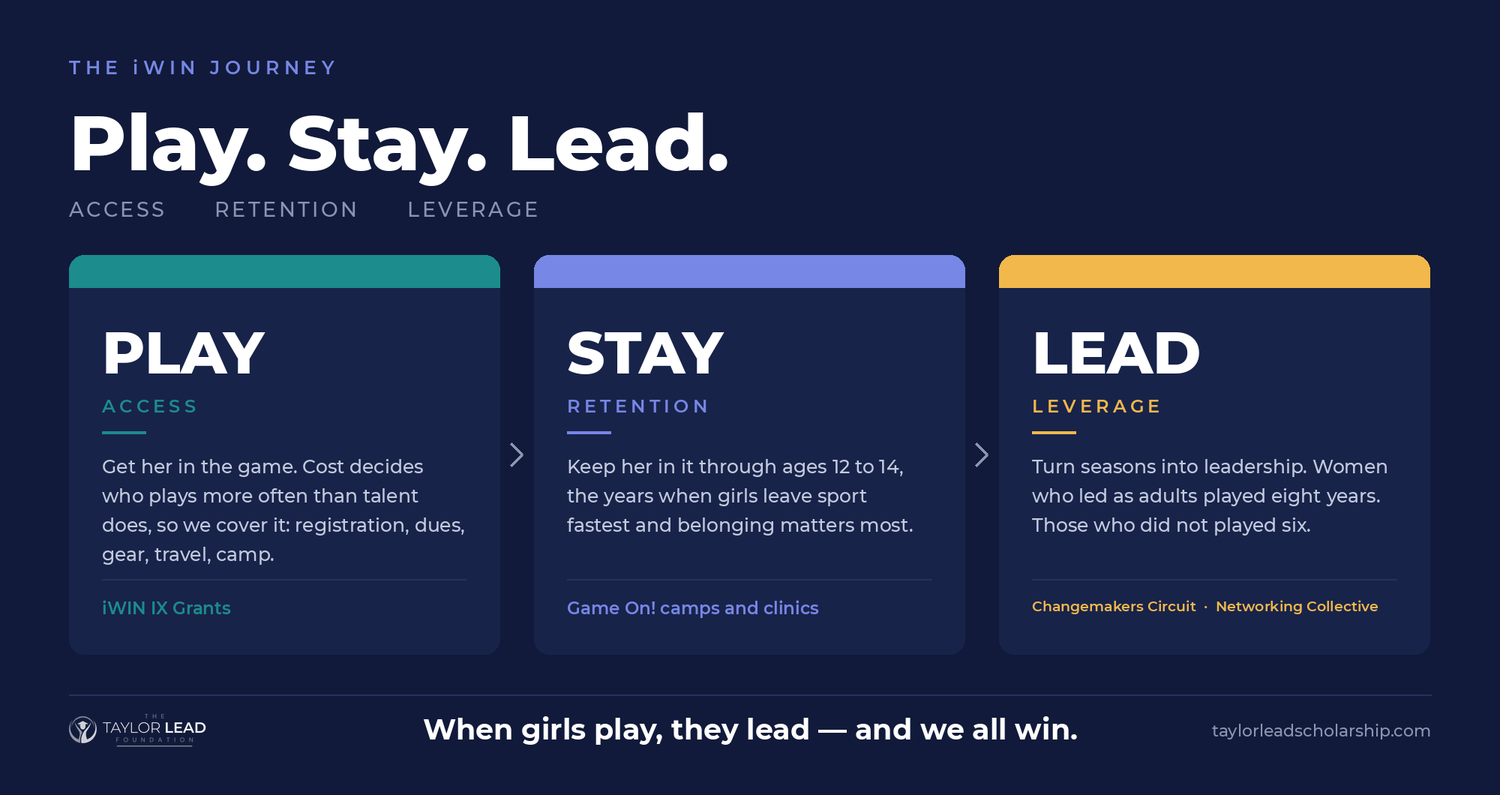
Most organizations in this field lead with conviction. We would rather lead with the four numbers that actually determine how we spend money, including the one that undercuts a claim we are often expected to make.
One: the gap is about income, not gender
The National Center for Health Statistics, drawing on the 2020 National Health Interview Survey, found 54.1% of American children aged 6 to 17 participated in organized sports. Girls: 52.0%. Boys: 56.1%.
Here is the part usually left out. That 4.1-point difference between girls and boys was not statistically significant. The report says so directly.
What was significant, at p < 0.05 on a linear trend, was income. Participation among children below the federal poverty level: 31.2%. Among children at 400% of the poverty level or above: 70.2%. A gap of 39 percentage points.
We publish this because the honest version is the stronger version. The federal data supports "this is an affordability problem" far more cleanly than it supports "this is a gender problem." Any organization presenting 52% against 56.1% as a meaningful gender gap is overstating what the source says.
Newer figures from the Aspen Institute's Project Play, drawn from the 2024 National Survey of Children's Health, show 58% overall participation, 54.9% for girls, 61.1% for boys, and 36.3% among the lowest-income households. The income gap in that data is 38.5 points.
Four years later, the gap has not closed. That is the finding that should be uncomfortable.
This is why iWIN IX Grants are our first program rather than our third.
Two: the leaving happens in early adolescence
Girls leave sport at roughly twice the rate of boys by age 14, per the Women's Sports Foundation. The Aspen Institute has published 1.3 times.
We cite both, and the spread is the point. Two credible national organizations disagree by nearly a factor of two on the most important attrition statistic in the field. Neither publishes anything for Idaho.
That is the clearest case we can make for why a state-level research effort deserves funding. We intend to build one. To be plain about status: it is planned, not underway.
This is why Game On! camps and year-round clinics target the 12 to 14 window specifically.
Three: duration is the mechanism
The Women's Sports Foundation's 2024 Play to Lead report surveyed 2,886 women who played on girls' or women's teams, nationally representative, fielded by YouGov, IRB-reviewed at the University of Massachusetts Amherst.
Women who went on to hold formal adult leadership roles had played sports for an average of eight years. Women without formal leadership roles averaged six.
This is the most useful statistic available to us, because it converts a correlation into something closer to a dose. Nearly every other figure in this field says sport and leadership travel together, which does not tell you where to intervene. This one says the intervention is keeping her in it for two more years.
Related findings from the same report: 69.1% held at least one formal leadership role outside the family. 48.6% credit the skills acquired through sport for their leadership development. 67% carried skills from sport into adulthood. Of those who held a formal leadership role, 70.7% reached manager-through-C-suite titles, which is 54.2% of the full sample.
The widely circulated figure that 94% of women in the C-suite played sport comes from EY and espnW in 2015: roughly 400 self-selected senior executives, five countries, correlational, eleven years old. We cite it, attributed, and never as the headline.
This is why the iWIN Networking Collective and the Changemakers Circuit exist at the far end of the pipeline.
Four: Idaho is under-measured
The NFHS recorded 23,423 girls' high school sports participations in Idaho in 2024–25, against 31,440 for boys. A gap of 8,017. Idaho ranks 36th nationally.
The survey counts participations rather than students. A three-sport athlete is counted three times, the individual-student figure is meaningfully lower, and nobody publishes it. We do not compute cost-per-girl from this number, because any such figure would be wrong in our favor.
Idaho girls play, in order: volleyball (4,154), outdoor track and field (4,101), basketball (3,027), soccer (2,252), fast-pitch softball (2,083), competitive spirit (1,820), cross country (1,470), tennis (1,411), wrestling (848), dance (768), golf (763), and swimming and diving (661).
How this becomes three stages
Access. IX Grants cover registration, dues, gear, travel, and camp costs, plus organizational grants for gear libraries, facility time, coach stipends, and transportation. Year-round through Submittable, reviewed quarterly.
Retention. Game On! camps and clinics in the Greater Boise Area, built for the 12 to 14 window. Clinics active fall 2026, camps launching Summer 2027.
Leverage. The Changemakers Circuit and the iWIN Networking Collective, carrying the athlete identity into professional leadership.
Access, then Retention, then Leverage. Each stage is worth less without the one before it.
What we cannot claim yet
We have inputs, not outcomes.
To date: 14 scholarship recipients in 2026 from a pool of 72 interested students, $17,000 awarded, 20 girls funded into Girls on the Run through IX Grants, and an inaugural gala that raised $250,000+ with 308 attendees, 50 volunteers, and more than 40 student-athletes in the room.
Every one of those is money moved or people gathered. None is a retention figure, because we have not yet completed a season-over-season cycle. We will not have credible retention data until the fall 2026 clinic cohort is tracked into 2027. That tracking is planned rather than complete, and the first published figure will carry its sample size.
We say this plainly because the alternative is claiming an outcome we have not measured, and a program officer will find that faster than we would like.
Sources: Black LI, Terlizzi EP, Vahratian A. Organized Sports Participation Among Children Aged 6–17 Years: United States, 2020. NCHS Data Brief No. 441, August 2022. Aspen Institute Project Play, 2024 National Survey of Children's Health. Sharrow E, Staurowsky E, Davis B. Play to Lead. Women's Sports Foundation, September 2024. EY Women Athletes Business Network and espnW, 2015. NFHS High School Athletics Participation Survey, 2024–25.